Deep Sky Object in Winter
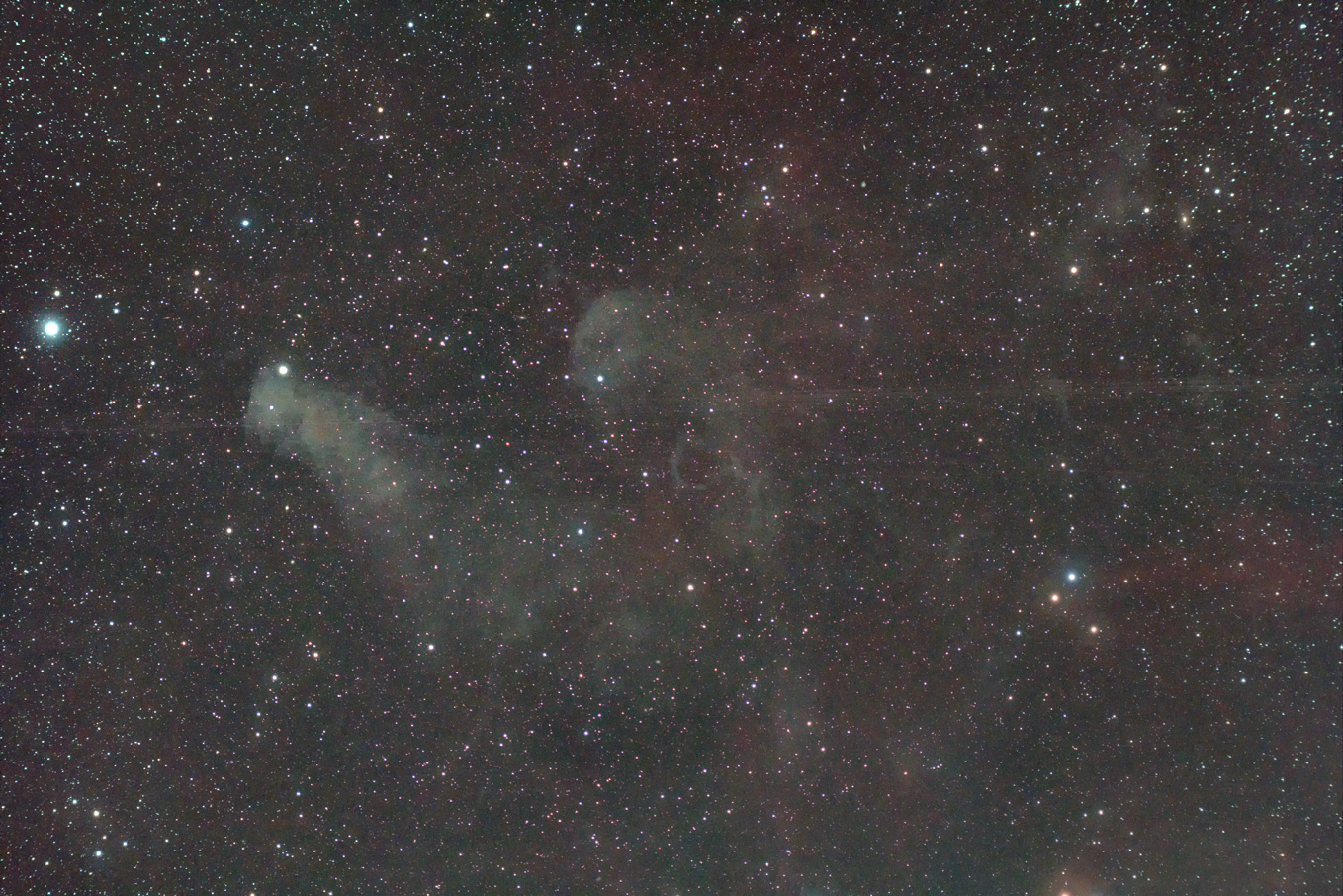
Around LBN906, LBN917 (Molecular Clouds in Eridanus)
Click on image to enlarge
| Date & Time: | Nov 15 2025, from 26:05 to 27:37 JST(+0900) |
| Composed 12 shots with 6 minutes exposed |
| Optical: | BORG 67FL with a conversion lens (f=210mm, F3.4) |
| with IDAS LPS-D1 light-pollution suppression filter |
| Auto-guided with TAKAHASHI EM-200 Equatorial |
| CMOS Camera: | ZWO ASI2600MC Pro (Cooled temp.: -20°C) |
| Location: | Tamura city, Fukushima pref. |
| Camera Settings: | Recording format...16bit FITS, converted to 16bit TIFF(6248×4176) |
| Device Size...23.5×15.7mm, Gain...100 |
| LBN906 / Molecular Cloud, type 4 R |
|---|
| R.A. | 04h 41m 00.0s (2000.0) |
|---|
| Dec. | -05°24' 00" (2000.0) |
|---|
| Apparent Size | 40×30' |
|---|
| Real Size | N/A |
|---|
| Magnitude | - |
|---|
| Distance | N/A |
|---|
|
| LBN917 / Molecular Cloud, type 3 R |
|---|
| R.A. | 04h 47m 42.0s (2000.0) |
|---|
| Dec. | -05°55' 00" (2000.0) |
|---|
| Apparent Size | 70×30' |
|---|
| Real Size | N/A |
|---|
| Magnitude | - |
|---|
| Distance | N/A |
|---|
|
This image captures faint molecular clouds spread across the northeastern corner of Eridanus.
The bright star at the left edge of the frame is ω Eridani. LBN 906 locates 3 degrees west of it, and the densest molecular cloud LBN 917 is lying 1.5 degrees west of the star.
These molecular clouds are part of the large star-forming region known as the Orion-Eridanus superbubble, and the way the gas disperses southwestward like a windsock is striking.
Additionally, you can detect that the extremely faint but pervasive Hα-emitting nebulosity extends across the entire field of view.
|
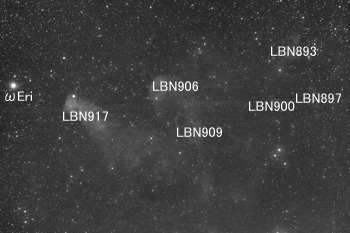 |
Objects around LBN906, LBN917 |